Washer and Dryer Combos for Every Home and Budget
Laundry day is something we all have to deal with, so having the right machines actually matters. A solid laundry pair makes the whole process smoother, from the moment you toss in the first shirt to when you pull out warm, dry towels. Top load pairs are the classic choice for a reason. They are easy to load, usually have larger capacities for bulky items, and let you add that forgotten sock mid-cycle without a mess. If you are ready to upgrade your laundry room, browse our lineup and find the perfect match for your home at The Brick.
Top Load Laundry Pairs
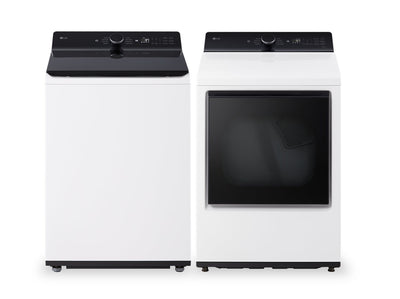
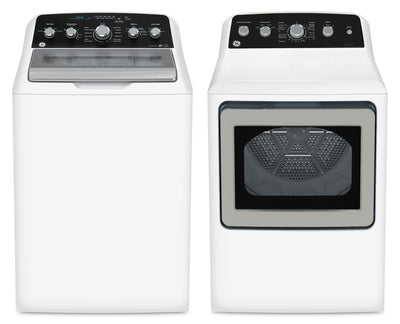
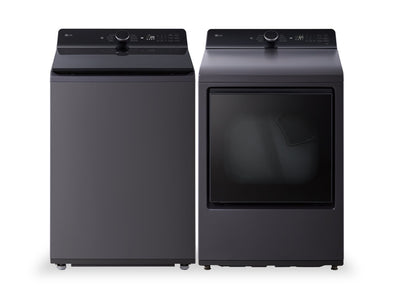
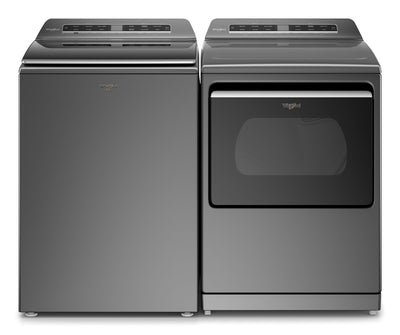
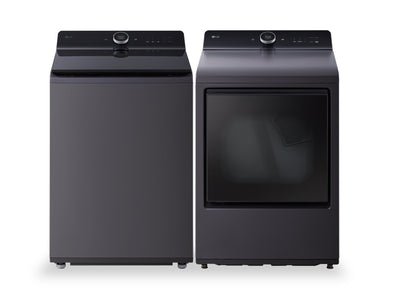
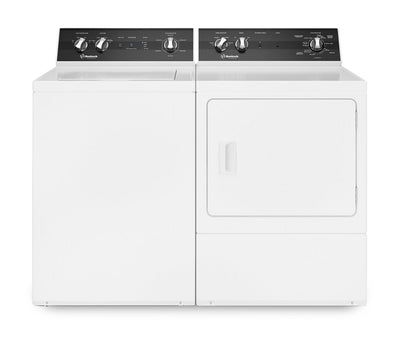
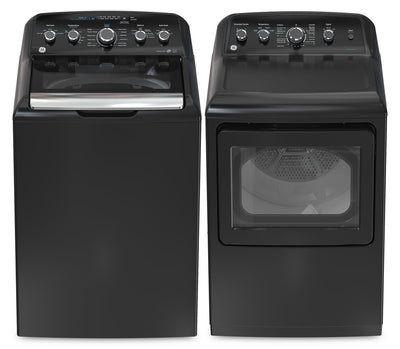
A top-load laundry pair consists of a top-load washer and a matching dryer installed side by side. Standard top-load washers are approximately 27 inches wide, 42 to 44 inches tall, and 27 to 28 inches deep. A side-by-side pair requires approximately 54 to 57 inches of width in the laundry space, with clearance for door and lid openings on both machines. The washer lid opens fully upward, which requires unrestricted overhead clearance — a low ceiling or overhead shelf must be measured against the fully-open lid height before purchase. You can browse individual washers in our Washers collection and dryers in our Dryers collection.
Agitator vs Impeller Top-Load Washers
The most important technical distinction within the top-load washer category is the wash system: agitator or impeller. Agitator washers use a tall central post with fins or vanes that twists back and forth during the wash cycle, physically moving clothes through the water. The central post occupies space in the drum, reducing available load capacity. Agitator washers use more water per cycle and complete cycles faster. They are more effective at removing heavy soiling and are better suited to heavily soiled workwear, sports gear, and items that need vigorous mechanical action.
Impeller washers use a low-profile rotating disc or cone at the bottom of the drum that creates a rolling water current, moving clothes against each other rather than against a central post. Without the agitator post, the drum has more usable space, which allows for larger loads and bulkier items such as duvets and comforters. Impeller washers use less water and energy per cycle but take longer to complete a cycle. They are gentler on fabrics and better suited to delicate items and mixed loads. The choice between agitator and impeller depends primarily on typical load type — heavily soiled items favour an agitator; large mixed loads with fabric care as a priority favour an impeller.
Why Standard Top-Load Washers Cannot Be Stacked
A standard top-load washer cannot be stacked beneath a dryer because the dryer would block the upward-opening lid. This is a fixed physical constraint — no stacking kit resolves it. Households with a top-load preference that also need a stacked configuration have two options: switch to a front-load washer paired with a compatible front-load dryer using a stacking kit, or purchase a unitized laundry centre.
Unitized Laundry Centres
A unitized laundry centre is a single appliance in which a top-load washer and a dryer are permanently factory-assembled as one vertical unit — the dryer sits above the washer and the two cannot be separated. This is the only way to have a top-load washer in a stacked configuration. Unitized centres are available in 24-inch and 27-inch widths. The 24-inch GE Unitized Spacemaker models measure approximately 24 inches wide, 74 to 75 inches tall, and 27 inches deep, with washer capacities of 2.3 to 4.4 cu. ft. and dryer capacities of 4.4 to 5.9 cu. ft. The 27-inch models are approximately 26.75 inches wide, 75.87 inches tall, and 30.87 inches deep.
Because the two units are permanently joined, both the washer and dryer must be replaced together if one component fails. This is distinct from a separately stacked front-load pair, where each machine can be serviced or replaced independently. Unitized centres require a single water supply connection, drain connection, and electrical or gas hookup, which simplifies installation in laundry closets where connection access is limited.
Stacked Front-Load Pairs
A stacked front-load pair uses two separate machines — a front-load washer and a compatible front-load dryer — connected by a manufacturer-approved stacking kit. Standard front-load machines are approximately 27 inches wide and 38 to 39 inches tall individually, producing a stacked height of approximately 77 to 80 inches. The stacked configuration requires approximately 29 inches of width and 80 inches of height clearance, with 32 to 34 inches of depth. Compact front-load models are available in 24-inch widths for narrower spaces, with a stacked height of approximately 74 to 78 inches.
The stacking kit must be the model specified for the exact washer and dryer combination — not all front-load washers and dryers from the same brand are stacking-compatible with each other. The kit's compatibility list should be confirmed before purchase. Because the units remain separate, either machine can be replaced independently if needed, and both machines can be unstacked and returned to a side-by-side configuration if the household moves or the laundry room layout changes.
Measuring Your Laundry Space
Before selecting any laundry configuration, four measurements should be confirmed: the available width of the laundry space, the available depth from the wall to any obstruction in front of the machines, the ceiling height for lid clearance on top-load or stacked configurations, and the doorway dimensions through which the appliance must pass during delivery. For unitized centres and stacked pairs, the doorway height is particularly important — a 75 to 80-inch unit cannot be tilted horizontally through a standard doorway without the door frame accommodating the diagonal. Delivery crews typically assess this during scheduling, but confirming it in advance prevents delivery-day complications.
FAQ About Top-Load and Stackable Laundry
Can a standard top-load washer be stacked beneath a dryer?
No. A standard top-load washer cannot be stacked beneath a dryer because the dryer would permanently block the upward-opening washer lid. The only way to have a top-load washer in a stacked configuration is to purchase a unitized laundry centre, where both machines are permanently factory-assembled as a single vertical unit.
What is a unitized laundry centre?
A unitized laundry centre is a single appliance in which a top-load washer and a dryer are permanently joined at the factory as one unit. It is available in 24-inch and 27-inch widths and requires one water connection, one drain, and one electrical or gas hookup. Because the units are permanently joined, both machines must be replaced together if one component fails, unlike a separately stacked front-load pair where each machine can be replaced independently.
What is the difference between an agitator and impeller top-load washer?
An agitator washer uses a tall central post that twists back and forth to move clothes through water — it uses more water, completes cycles faster, and is more effective on heavily soiled loads. An impeller washer uses a low-profile rotating disc at the drum floor that creates a water current, moving clothes against each other — it uses less water and energy, handles larger loads including bulky items, and is gentler on fabrics. The agitator central post reduces drum space; the impeller design leaves the full drum interior available for loading.
What dimensions do I need for a stacked front-load pair?
A standard stacked front-load pair requires approximately 29 inches of width, 32 to 34 inches of depth, and 77 to 80 inches of height clearance. Compact 24-inch models stack to approximately 74 to 78 inches in height. The stacking kit must be the model specified for the exact washer and dryer combination — not all front-load machines from the same brand are compatible with each other for stacking. Compatibility should be confirmed before purchase.
What is the difference between a unitized laundry centre and a stacked front-load pair?
A unitized centre is a single appliance with a top-load washer and dryer permanently assembled together — both must be replaced if one fails, and the configuration cannot be changed. A stacked front-load pair is two separate machines joined by a stacking kit — each machine can be replaced or serviced independently, and the pair can be unstacked to a side-by-side arrangement if needed. A unitized centre is the only option for a stacked top-load configuration; a stacked front-load pair uses front-load machines only.